


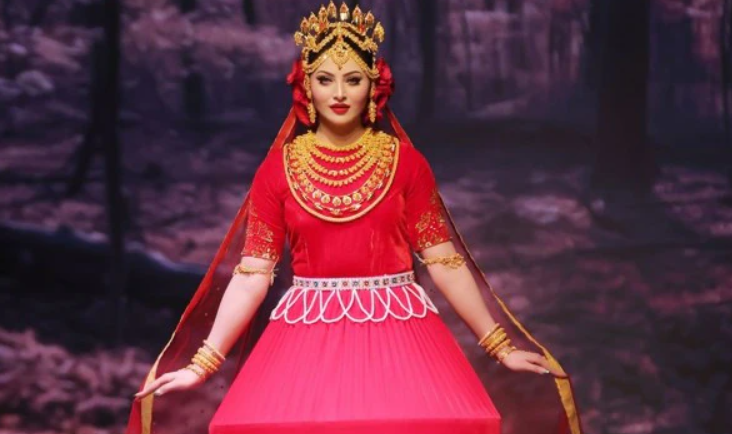
For the first time in fashion history, Urvashi Rautela walked the ramp wearing a traditional Manipuri bridal ensemble made of 24-karat gold. Designed by Imphal-based designer Robert Naorem, the model and actor dazzled in a striking red kumin potloi, a traditional outfit worn by Manipuri women during weddings and cultural events like Rasa Leela performances. Her ensemble, featuring intricate khoi and kumin hand embroidery with gold stone embellishments, was paired with gold jewelry.
On Instagram, designer Robert Naorem described the outfit as embodying a “Manipur modern aesthetic, both relevant and timeless.” To understand more about the attire, Ruhi Munjial, Assistant Professor at NIFT Panchkula, shared insights into the kumin potloi. She explained that the cylindrical skirt is crafted from thick fabric, reinforced with bamboo, and adorned with satin, mirrors, glitter, and other decorative elements. The outfit typically includes a woven belt around the waist and an innaphi, a delicate muslin shawl draped over the upper body.
Munjial further elaborated on the cultural importance of the potloi, particularly for the Meitei Hindu community. The potloi was introduced by Maharaja Bhagyachandra (1749–1798) for dancers performing the Rasa Leela, a classical Manipuri dance depicting the love between Lord Krishna and the Gopis. Originally, the stiffened skirt was meant to conceal the feet of the dancers from Krishna, symbolizing modesty and reverence. Over time, the potloi became an integral part of Manipuri bridal attire, with the skirt being stitched onto the bride before the ceremony.
As for the jewelry, Munjial noted that the headdress, called the kajenglei or leitreng, is intricately crafted, often using gold, silver, or other precious materials. Other accessories include brass or jari ornaments like samjinam and samjithet, traditionally worn with a bun, and a thin scarf that covers the bun from behind. Urvashi’s headgear resembled those introduced during Maharaja Chandrakirti’s reign in 1850, later adopted in 1941 for the Diva Ras under Maharaja Churachand’s reign. The associated ornaments include the mini, worn along the hairline; the karnal, which covers the ears; and the kulak, a butterfly-shaped silver jari ornament placed on either side of the hair parting.