



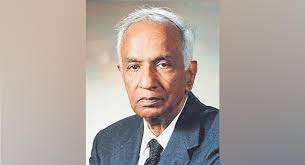
Subrahmanyan Chandrasekhar, an Indian-American astrophysicist, remains one of the most influential scientists of the 20th century, celebrated for his groundbreaking work on the structure and evolution of stars. His most significant contribution, known as the “Chandrasekhar Limit,” revolutionized the field of astrophysics by explaining the fate of stars at the end of their life cycles.
Born in 1910 in Lahore, British India (now in Pakistan), Chandrasekhar showed early promise in mathematics and physics. After completing his education at the University of Madras, he pursued further studies at the University of Cambridge, where he made the discovery that would define his career. At just 19 years old, Chandrasekhar calculated that a star with a mass greater than 1.4 times that of the Sun would undergo gravitational collapse, becoming a neutron star or black hole, rather than a white dwarf, the previously accepted outcome for all stars.
Initially, his theory was met with skepticism, but over time, it gained widespread acceptance as observational evidence confirmed his predictions. The “Chandrasekhar Limit” became a cornerstone of modern astrophysics, helping scientists understand the formation of some of the universe’s most exotic objects, including black holes.
Chandrasekhar’s contributions extended beyond stellar evolution. He worked on a wide range of topics in physics, including fluid dynamics, general relativity, and quantum theory. His lifelong dedication to research earned him numerous prestigious awards, including the Nobel Prize in Physics in 1983, shared with William A. Fowler for their discoveries related to the evolution of stars.
Throughout his career, Chandrasekhar remained deeply committed to teaching and mentoring young scientists. His influence on astrophysics endures, with his work continuing to inspire generations of researchers. Chandrasekhar’s legacy is not only in his scientific discoveries but also in his exemplary pursuit of knowledge and intellectual rigor.